VJ RETURNAL.
Playing the
image.
Self-built animations, AI movie clips and a live visual practice. With my daughter Noa at the controls.
I perform as VJ RETURNAL. I like creating my own visual shows: images I can play with, put into motion and bring into a room with music. A graphic idea begins on a screen, but its character changes when it becomes a projection and part of a live moment.
My sets bring together two things I enjoy making: precise animations I have vibe coded myself, and movie clips created with AI. I also use my Teenage Engineering OP-Z in this practice. Code, moving imagery and physical controls give me different ways into the same question: what should the image do now?
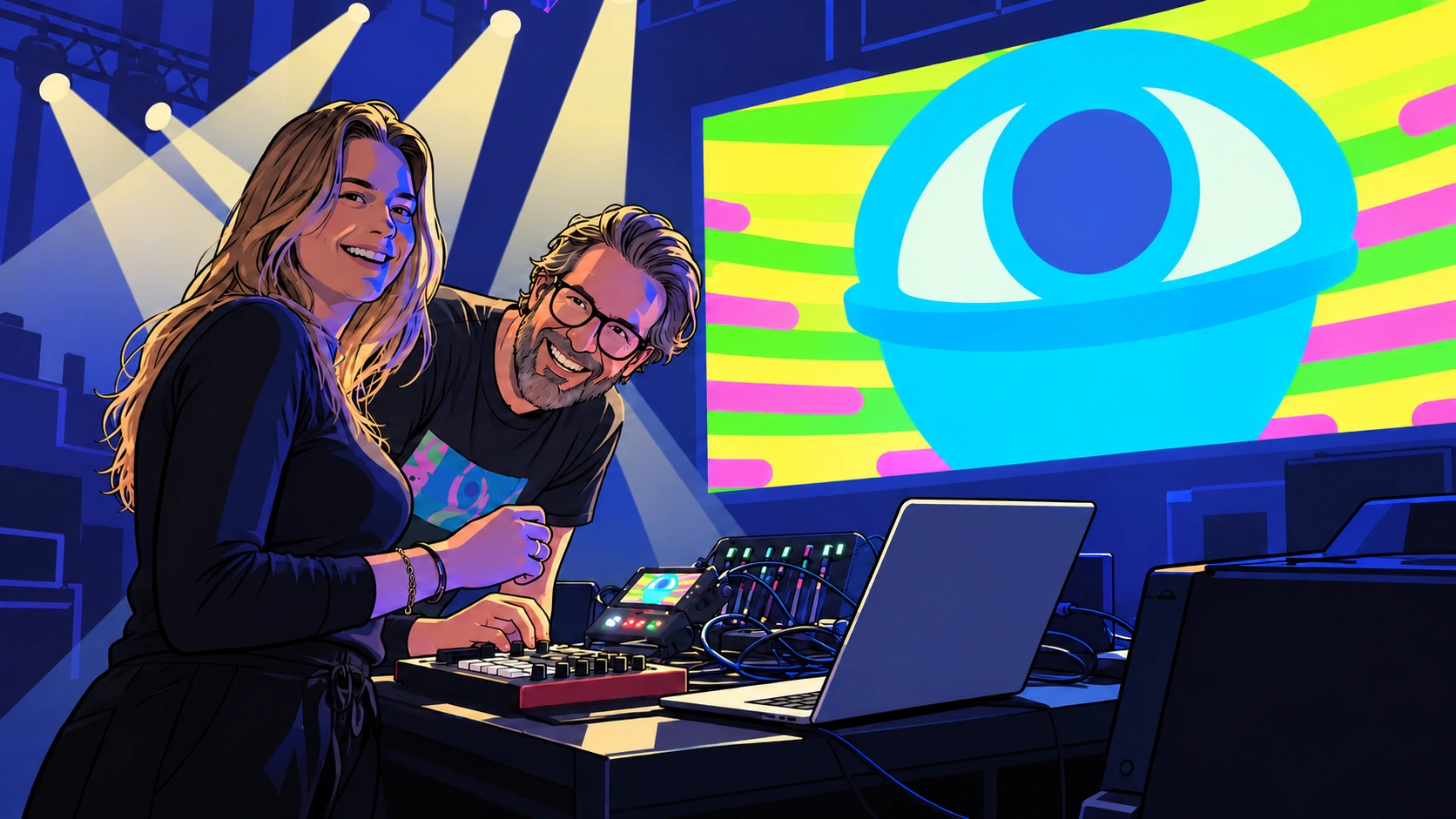
The photograph with the large eye captures something I love about this work. There is a table full of tools, a bold visual filling the screen and my daughter Noa beside me. She was there for the show, and she also had a turn at the VJ controls. The making became something we could share.
Design a show you want to play.
I approach a VJ show as a visual language. I think about the shapes, colours and kinds of movement that belong together. A simple eye, a repeating pattern or a field of moving points can each have a strong character. I want enough coherence for a show to feel like mine, with enough room for it to change.
There is a particular pleasure in watching a very clear graphic become large. A shape that looked neat on a laptop can feel bold and physical when it fills a screen. Its movement matters differently too. The interval between changes, the time a colour stays visible and the space around an object all become part of the experience.
Preparing that material is already a form of design. I am choosing what deserves attention and which elements can carry a sequence. Then the performance asks me to keep making those choices in time. A composition has to keep working while it moves.
Two visual languages, one set.
The coded animations give me a direct graphic language: lines, shapes, repeated forms and deliberately controlled movement. I can start with a visual rule, try it and adjust it until the rhythm feels right. The simplicity gives me something clear to work with during a show.
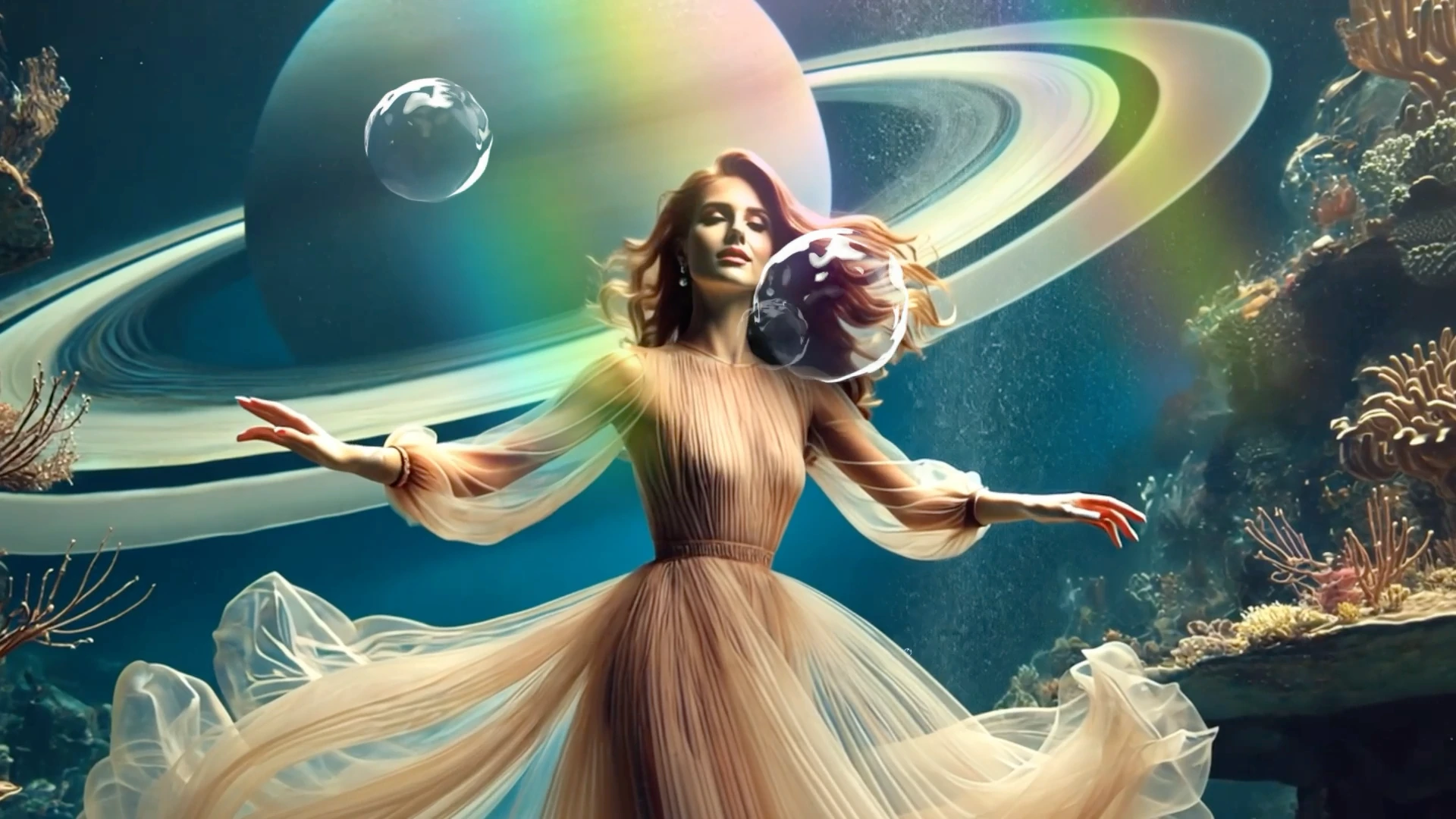
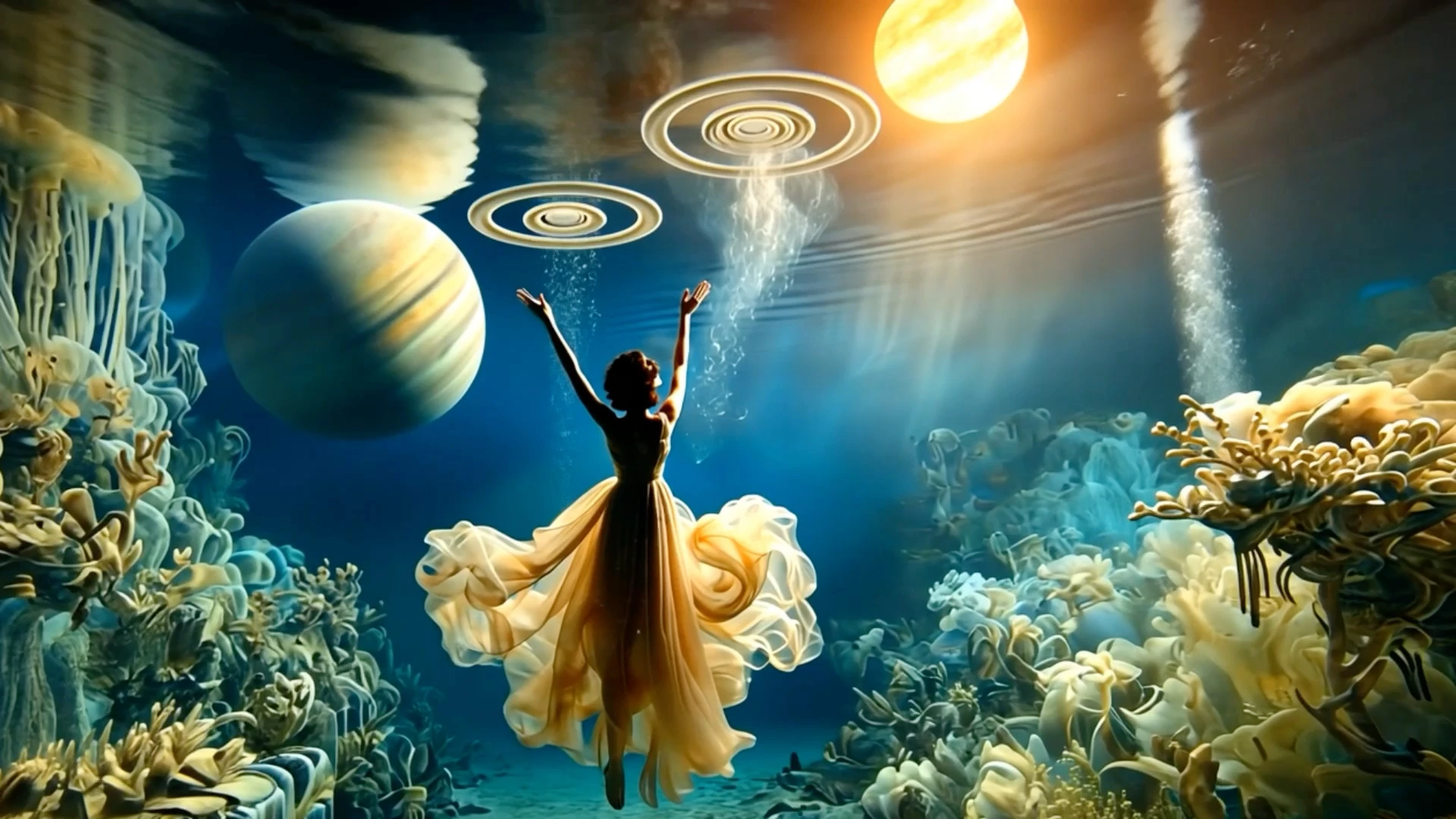
AI movie clips open up another kind of imagery. The stills here show the atmosphere I explore: a figure in flowing fabric, floating spheres, planetary rings and scenes somewhere between an underwater world and a dream. They give me texture, depth and a sense of possibility that is very different from a sharply drawn graphic.
I enjoy composing with that difference. A clean animation can establish a rhythm; a film image can make the space feel more expansive. Bringing them together involves choosing which material belongs in the moment, how long to let it work and when to move on. Generating or coding the material is only one part of making a show.
Vibe coding becomes an instrument.
I have built a standalone VJ app in Processing. Looking back through the earlier experiments, the intention was already clear: a fullscreen visual environment, effects I could trigger from the keyboard and movement that could respond to sound from a microphone.
I explored changing visual modes, working with moving forms and adjusting microphone sensitivity. The important thing for me was to make a visual system I could actually interact with. A screen full of possibilities becomes more useful when I can learn how to play it.
Vibe coding gives me a way to work from a visual intention towards a functioning experiment. I can describe the movement I want, try the result, notice what feels wrong and work through another version. My design judgement is involved at every step: the density of the image, the character of the motion and the clarity of the controls.
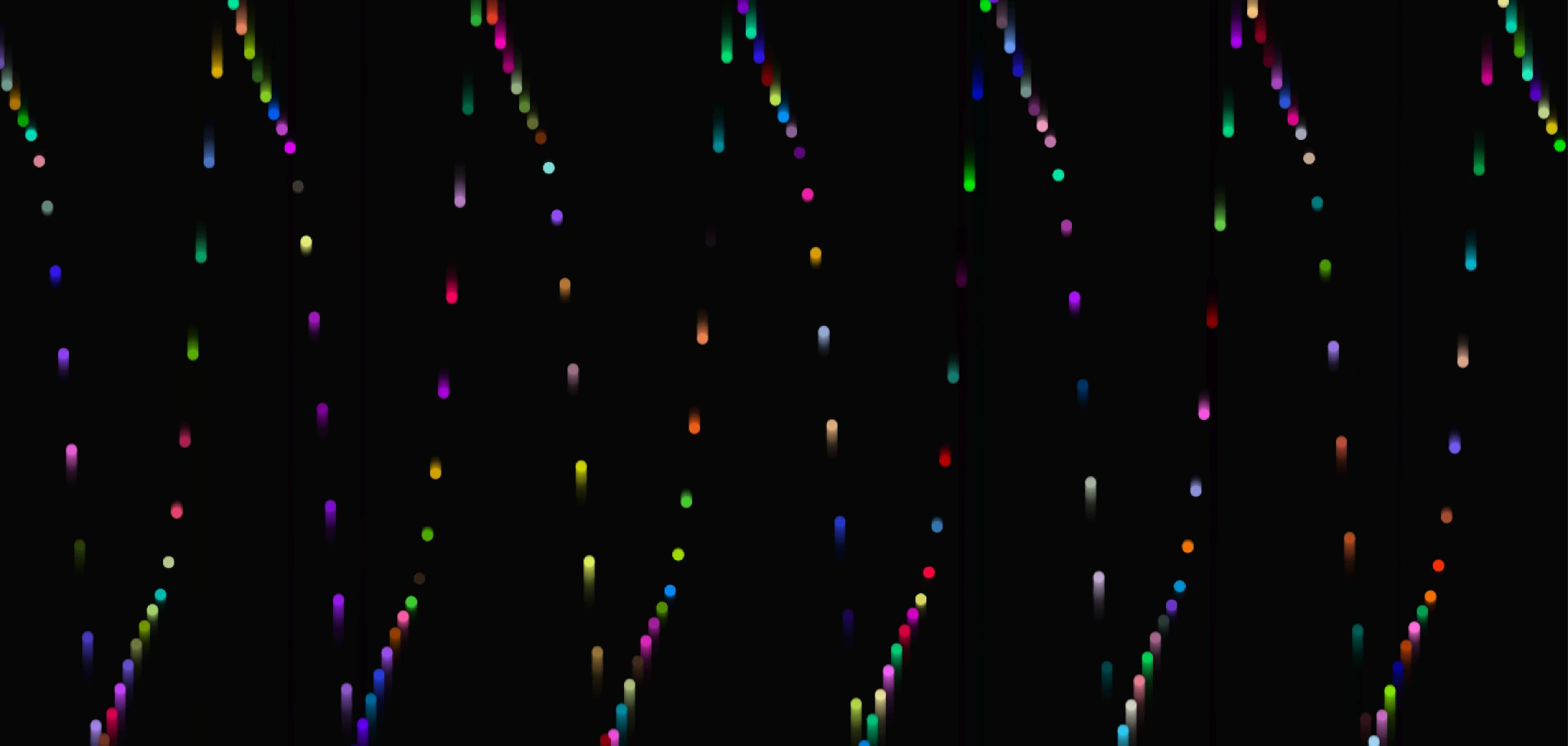
The final screendump here comes from that Processing work. Coloured points leave trails against black. Even in a still image, I can see the attraction of a simple rule producing a larger pattern. When I build these systems, I am giving myself material for the next performance as well as exploring an idea.
Hands on the controls.
My Teenage Engineering OP-Z also has a place in this practice. I enjoy working with a compact physical instrument alongside a laptop. It connects with my interest in sound, pattern and the feeling of playing, and it is part of the setup I bring to my VJ work.
Physical controls change my relationship with an image. There is a satisfying immediacy in making a choice with my hands and seeing a visual response. I want the tools to leave room for that exchange, so my attention can move between the material, the music and what is happening in the room.
I think of preparation as learning the possibilities of the set. The more familiar I become with the material, the more confidently I can choose when to use it. That confidence also gives me room to leave a visual alone for a while and let it establish itself.
I design the possibilities, then discover the show by playing them.
Sander Oord / VJ RETURNAL
A turn at the controls for Noa.
Noa was with me at the show, and she also got her hands on the VJ controls. I like having that moment in the story. The tools I work with can become a shared experience, with someone else finding out what happens when they make a change.
When I make an animation, I have spent a lot of time looking at it through my own intentions. Letting someone else play with it creates another way of looking. It reminds me of the curiosity that made me want to build the system in the first place.
Sharing that with my daughter means a lot to me. The photograph holds both parts of the evening: the visual work filling the screen, and the pleasure of being there together. I want RETURNAL to have room for that kind of play.
Read the visual description
A portrait recording of a stage projection in a dark room. A figure appears within layered graphic contours, with coloured stage lighting around the screen.
Read the visual description
A landscape recording of a live performance. A large screen behind the performers shows a face and changing imagery; blue and purple stage lights fall across the room and audience.
What the live image teaches me.
VJing brings several parts of my practice together. Design gives me a sense of composition and graphic clarity. Building an app lets me make an idea behave. AI helps me explore moving worlds. Performing gives all of that a setting in which timing and judgement matter immediately.
It also reminds me how much a context can change an image. On a screen at home, I can study every detail. In a live room, I need to consider its scale, its pace and the attention it asks from people. Something very simple can carry a moment beautifully.
That is what keeps me interested in making my own shows as VJ RETURNAL. I want to keep developing a visual language, building tools that invite play and discovering what happens when the material meets music and a room. And sometimes, the next possibility begins with giving Noa a turn at the controls.