The Art of
Stepping Back
Sometimes you need distance to see what's been there all along.
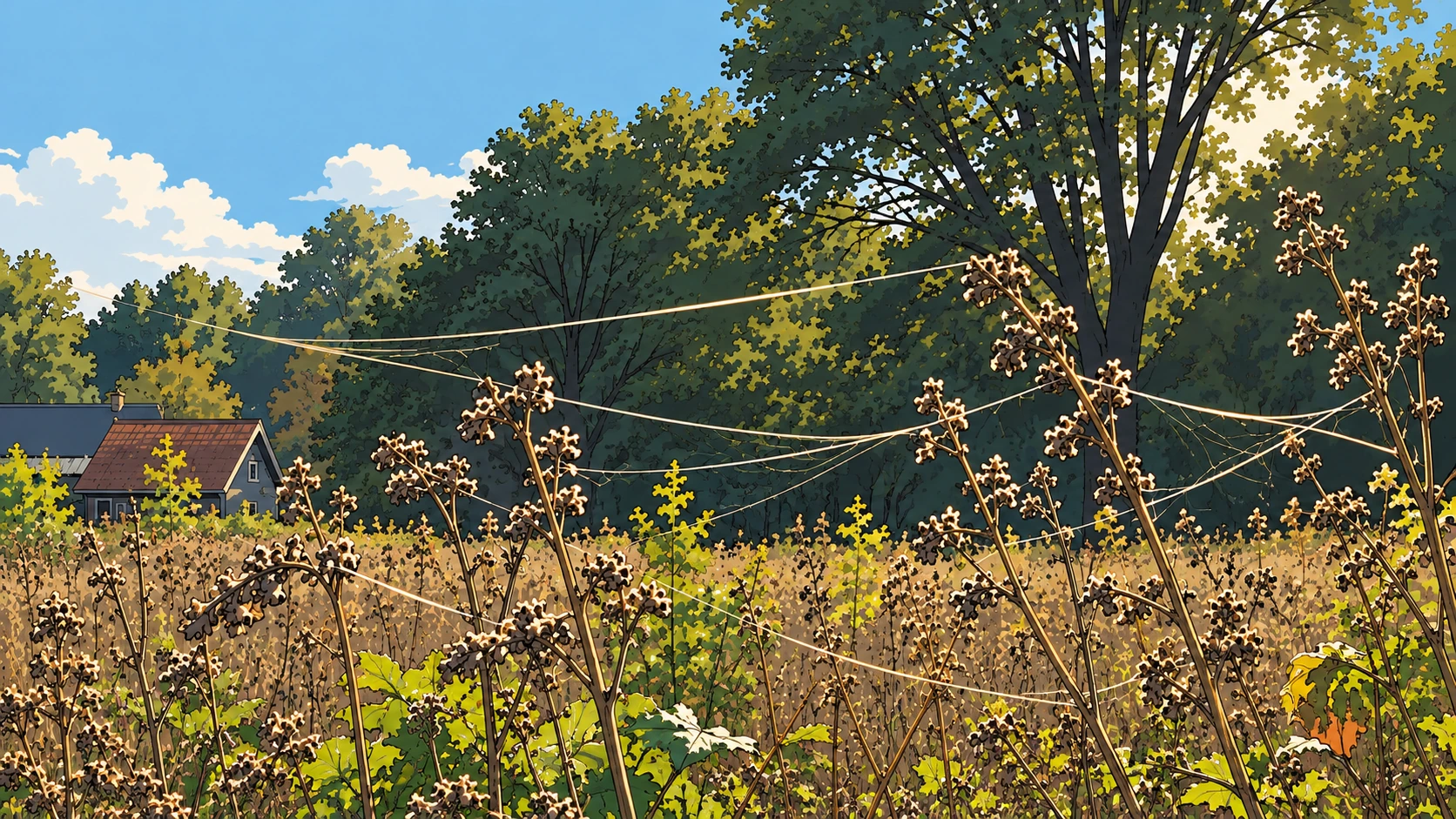
During a short break in the woods, I sat down on a bench. In front of me were plants, dry stems and seed heads, with trees behind them. An ordinary scene. I had time to look at it without needing to get anywhere.
Then the sunlight caught something between the plants. Fine threads, almost invisible a moment before, appeared as pale lines across the darker background. They reached from one stem to another, hovering in the spaces I had barely noticed.
Little bridges of light.
They looked like tiny bridges suspended in the air. Perhaps some of the silk had drifted into place on the wind; I could only guess how it had arrived. What drew me in was the way it connected the plants. One delicate line, then another, then a whole network coming into view.
There was something dancing about those threads. They were loose enough to bow and shift, yet held a rhythm of their own. Across the upright stems ran these long, nearly horizontal marks. The sunlight picked them out, and suddenly the little patch of plants felt like a composition.
I found myself looking at intervals, directions and the spaces between the lines. Nature became almost abstract for a moment. I could still see leaves and seed heads, but another reading had opened up: a quiet arrangement of tension, movement and light.
Read the visual description
A view across dry stems and green leaves at the edge of the woods. Thin strands of spider silk stretch almost horizontally between the plants, catching the sunlight against the darker trees behind them.
The bench changed the picture.
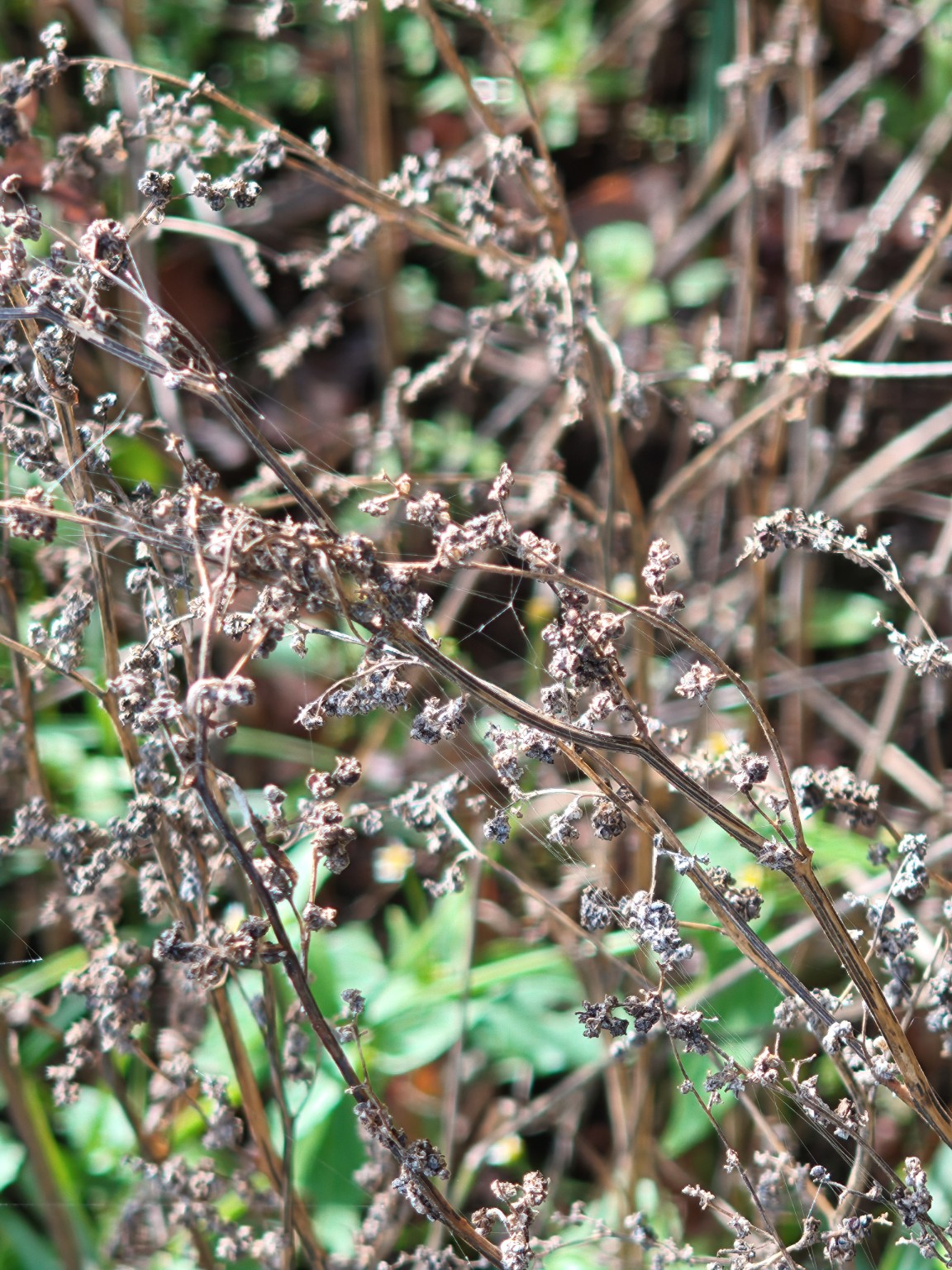
Close to the plants, those connections had been difficult to see. My attention was on the individual stems and everything around them. From the bench, with a little distance and the sun at the right angle, the threads began to stand out together.
That change touched me. The beauty had been there before I noticed it. Sitting down gave me a different relationship with the scene. I could let my eyes settle, follow a line and discover where it went.
I often think of looking as an active thing: move closer, inspect, find the detail. This was a reminder that looking also involves choosing where to be and giving a scene time. A few steps back can bring connections into view that disappear when each detail fills your attention.
Sometimes the most useful move is to give your eyes a little more room.
Sander Oord / A field note
What I take back to the studio.
As a designer, I carry moments like this back into my work. The fine horizontal lines, the rhythm between the stems, the way a small shift in contrast made a connection visible: these are things I recognise in a layout, an image or an identity.
I do not need to turn the plants into a design. The observation stays with me as a way of seeing. It makes me more sensitive to the relationship between elements, to a pause in a composition, to the possibility that one quiet line could hold the whole together.
At my desk, I can become very absorbed in a detail. I keep adjusting a margin, a shape or a piece of type, and gradually lose sight of what the work is doing as a whole. The bench offers me a useful image for that moment. Step away from the screen. Let the work become something I can look at again.
Distance can take different forms. A print on the other side of the room. A walk before making the next decision. Showing the work to someone whose first impression I have not heard yet. Each can give me a little space to notice the relationships I have stopped seeing.
Wait for another light.
Distance was only part of what happened among the plants. The light mattered too. A thread could be present and still disappear against its surroundings. When the sun caught it differently, it became the most striking thing in the scene.
In design, another light might be a conversation, a different context or a return to the work the next day. A question from someone else can illuminate an assumption. Looking at a piece through the eyes of the person who will use it can reveal where the composition needs to become clearer.
I like the patience in that thought. There are moments when another immediate adjustment only adds noise. I can leave a question open for a while, let a different view enter and then make a more considered choice.
The threads stayed with me after the break was over. So did the bench. I want to remember that small place from which the ordinary scene became beautiful: a little distance, a moment of stillness and a willingness to look again when the light changed.