A synthesizer
you can rebuild
yourself
At a sale price of less than fifty euros, the M‑VAVE FM‑1 is already a surprise. The real shift begins when musicians, programmers and AI start reimagining the instrument together.
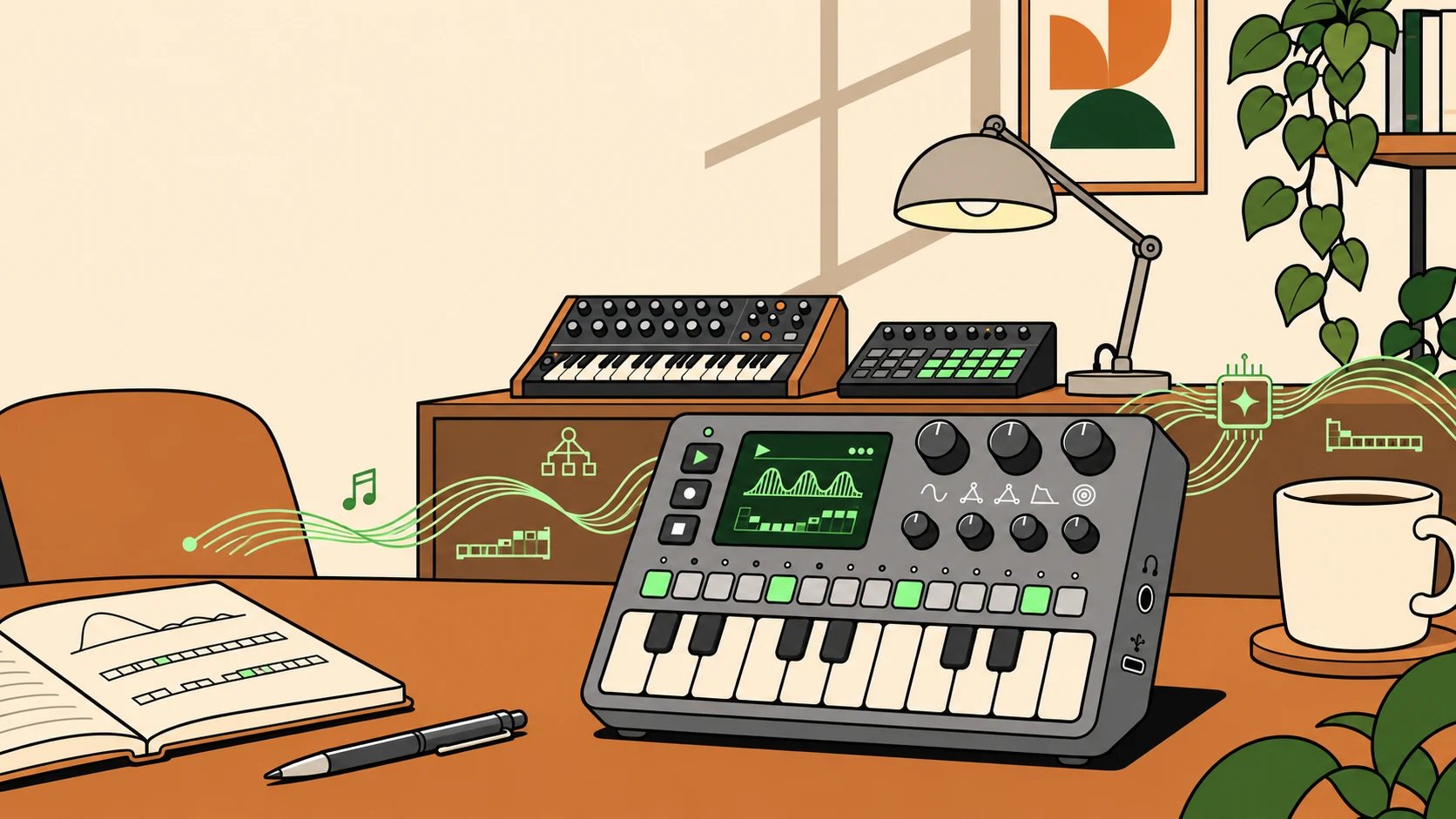
From instrument to platform
You usually buy a synthesizer for the sounds inside it. The manufacturer decides on the sound engine, the controls and the software. You can edit presets, sometimes install an update and often dig quite deeply into the parameters. But the foundations usually remain the manufacturer's. Turning the same device into an entirely different synthesizer is not a realistic option for most musicians.
The M‑VAVE FM‑1 shows how quickly that picture can change. In the screenshot I saved today, it was listed at €47.39. For that price, you get a compact FM synthesizer with a small keyboard, knobs, a sequencer and built-in effects. That is already a remarkable amount of instrument for the money. But the community has spotted something else: a small, affordable hardware platform on which new ideas can take shape.
That is the revolution that interests me. Not because the FM‑1 has suddenly become the best synthesizer in the world, or because every owner can now become a firmware developer overnight. What is changing is the barrier to entry. A lively community has emerged around understanding, modifying and reimagining the software. M‑VAVE has also published its own open firmware project and browser workbench. The boundary between using an instrument and helping to design it is becoming much thinner.
One box, different instruments
The community projects change the role of the FM‑1 in very different ways.
Felucca is one of the key open projects behind this wave. It turns the FM‑1 into a multi-track synthesizer and sequencer with several sound engines. Think FM, analogue-style sounds, drums, granular-like textures and physical models. Instead of a collection of presets, you get an environment for building and arranging parts.
SLOOP, built on Felucca, puts the emphasis on immediate performance. The device becomes a live groovebox: three synth tracks and a drum track, pattern and song functions, samples and effects you can bring into a performance. The controls are designed for hands-on playing: hold a button and use the keys as steps, sounds or performance effects. That is a different musical idea from the original FM synthesizer.
X0X takes another distinct direction. It brings together a ReBirth-like combination of 808 and 909 drums, two 303-style bass lines, breakbeats and a song mode in the same device. If you saw the FM‑1 mainly as a small FM keyboard, you can now turn it into a pocket acid and beat machine.
With FM‑1+VA, the original FM engine remains, while additions include a virtual-analogue sound engine, an 8-bit engine and an expanded 64-step sequencer. OberVave explores an Oberheim-inspired approach to polyphonic synthesis. Then there is FM1 Open, M‑VAVE's own official open-source project: an eight-track system with FM sounds, sampling functions and a browser environment.
These are not minor variations on a preset menu. They are different answers to the question: what kind of instrument do I want this to become? A groovebox, an acid machine, a polyphonic synth, a multi-engine sequencer, or the original FM instrument with a different interface.
Where AI comes in
These firmware projects were not all made with AI. That would be too broad a claim. They come from programming, reverse engineering, knowledge of the device and contributions from people sharing their code and experience. But an open environment like this makes it especially clear where AI can help musicians and makers.
A language model can help you understand documentation for an unfamiliar processor, set up a development environment, write example code, interpret an error message or quickly develop an interface concept. A musician can describe an idea in ordinary language — for example, "I want four tracks, with the knobs triggering effects while I play" — and use AI to break it into technical steps. The maker still makes the choices, checks the code, tests it on real hardware and decides whether it works musically.
That is a powerful combination. AI makes technical work more approachable and speeds up experimentation. Musical imagination gives the building process a direction. And the hardware brings the idea back to reality: do the controls feel right, does it sound convincing, will it stay stable on stage?
For me, the FM‑1 is a good example of AI as a creative partner, rather than an automatic hit machine. The value emerges from the loop between listening, imagining, building, testing and trying again. A prompt does not automatically produce a good instrument. But it can help someone take a first step towards making instruments who might otherwise never have started.
Watch and listen
The examples become clearest when you hear them. These videos explore different sides of the FM‑1 and its alternative firmware. The players and makers demonstrate their own work. Open a video on YouTube and press play to listen.
SLOOP: a live groovebox
Darren Lock Music demonstrates the FM‑1 running SLOOP. Listen for the difference between a sound module and an instrument you can use to perform patterns, drums and live interventions.
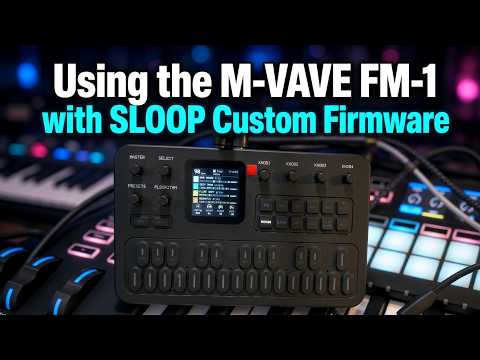 Watch on YouTube ↗
Groove OS: the FM‑1 as a pocket DAW
NatLife Sounds demonstrates Groove OS with synth sounds, sequencing, piano-roll-style input and automation. It is another route entirely: more of the production process inside the device itself.
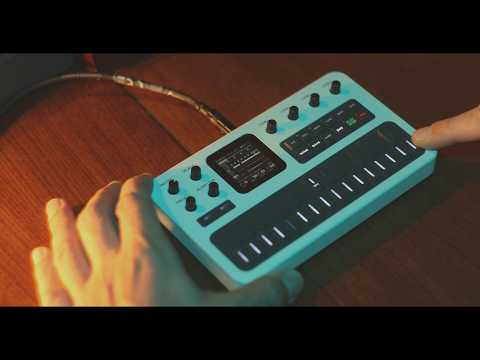 Watch on YouTube ↗
FM‑1+VA: FM meets virtual analogue
In this tutorial, NatLife Sounds demonstrates the additional VA engine and expanded sequencer. You can hear how a firmware choice changes the sound world of the very same hardware.
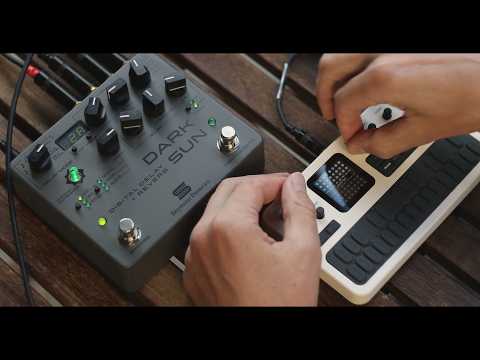 Watch on YouTube ↗
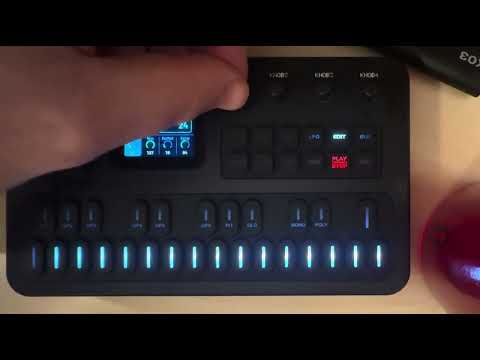
X0X: 808, 909 and acid
Charles Vestal demonstrates a very different musical identity with X0X: drums, acid lines and breaks in a compact groovebox.
 Watch on YouTube ↗
More say for the musician
There is a practical side, of course. Installing alternative firmware requires care. You need to understand what you are installing, back up your work and follow the maker's instructions. Firmware projects vary in maturity; features can change, and returning to the factory software is not necessarily straightforward for every user. Open does not automatically mean risk-free.
Yet that is part of what interests me. The FM‑1 shows that a musical instrument does not have to be designed as a closed, finished product. When the hardware is affordable, the software becomes adaptable and knowledge is shared online, a community can develop an instrument beyond what a single manufacturer's team could do alone.
AI can accelerate that movement. It does so by shortening the distance between a musical wish and a technical experiment, while the musician keeps the creative direction. Someone with an idea can build a first prototype sooner. Someone with programming experience can get to grips with documentation faster. And someone who mainly wants to play gains more ways to make the same little box sound and respond.
Perhaps that is the real revolution: for less than fifty euros, you can buy an instrument whose possibilities do not have to end with the software it shipped with.
Prices and firmware versions change quickly. The quoted price comes from the supplied product screenshot dated 5 November 2026. Community firmware is independent of M‑VAVE; check compatibility and backups before installing anything.