GTA with feathers.
Eyes everywhere.
A pigeon above Toronto. A browser game full of mischief. And beneath its glorious absurdity, an uncomfortable question: who is watching when nobody recognises the camera? COO shows how far a strong idea and AI can take you.
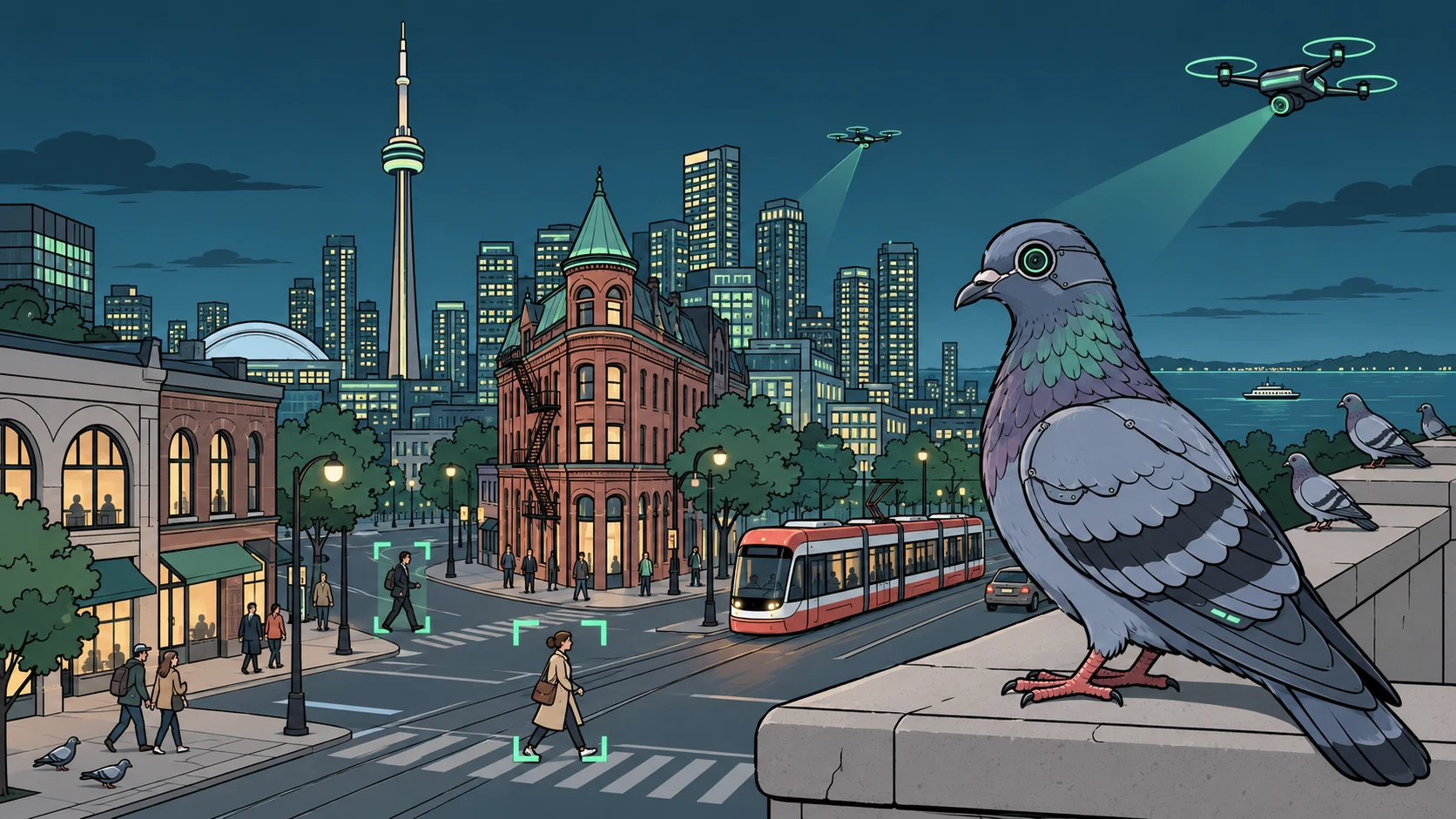
The city belongs to the pigeons.
Some ideas make you want to jump straight in. GTA, but you are a pigeon, is one of them. An entire city beneath your wings. Land on a roof, skim above the traffic and give someone on the pavement a spectacularly bad day. It is a wonderful premise: small, cheeky and immediately understandable.
The game is COO: Covert Ornithological Operations. You play P-7, a government drone disguised as a pigeon, with a handler called ROOST. You can take on missions or fly around freely. The city is Toronto, so the GTA joke also refers to the Greater Toronto Area. This is an independent project, not a Rockstar game. 1 2
What appeals to me is the combination of freedom of movement and an instantly recognisable role. Everyone knows how a pigeon behaves. That makes the leap into absurdity a small one. Of course the bird is sitting somewhere inconvenient. Of course it drops something. But this pigeon is collecting information at the same time. The nonsense serves a purpose.

The best camera goes unnoticed.
This is where COO touches a nerve for me. We tend to picture surveillance as something visible: a camera on a building, a drone with propellers or an officer on the street. The unsettling thing about this game is that the observing device disappears into everyday life. A pigeon belongs there. You barely look at it.
COO makes that part of the game. You observe people while trying to behave like a convincing bird. The Lens can display a dossier card for a passer-by; cooing helps you act naturally. The citizen becomes a target on your screen while you blend into the street. 2
I read that as a sharp sketch of a possible future. Imagine small flying sensors connected to automated recognition, location histories and databases. The question then goes beyond who gets to operate a camera. Who decides which person is interesting? Which movement becomes suspicious? How does someone realise they are being followed, and how can they challenge it?
That scenario is my interpretation of the game. COO is not evidence of an actual spy-pigeon programme. But the image is powerful: a city where everyone feels free can also be an environment in which every person is treated as a clickable object. Sitting at the controls yourself makes that position of power feel surprisingly natural.
A privacy maker behind the camera.
The creator is Yegor Sak, co-founder and CEO of Windscribe. The company builds VPN and privacy software and speaks out against surveillance and invasive tracking on its own website. That background makes this game particularly interesting to me. 3
Without a statement from Sak, I cannot establish exactly what political message he intends. The decision to put you in control of a camouflaged government drone does give the game a clear tension. You enjoy actions that would feel very different to the person standing in the street.
I find that effective satire. A long argument about control keeps you at a distance. A small game lets you experience the temptation: zoom in once more, follow another person, complete another assignment. The interface makes it easy. The citizen does not have to click anything to become part of your game.

Yes, AI helped build this.
The suspicion that COO was made with AI is confirmed by its creator. Sak reports around 165,000 lines of JavaScript, built in seven days, with up to ten parallel AI workstreams and 35,218 Claude model calls. He says he used no game engine or external visual assets. These are his own development figures, not an independently audited measurement. 4
The city also starts with real data, according to Sak: 630 km², 438,819 buildings with heights from city data and around 5,700 kilometres of streets. He describes procedural dialogue, locally synthesised neural voices and live ADS-B air-traffic data. JavaScript and WebGL bring the world into the browser. 1 4
Several forms of automation come together here. City data provides the basis of the environment; code turns it into a playable world. AI helped with the development, according to Sak. That distinction matters. It does not automatically mean every building is an AI-generated image, or that Claude invents every action live as you play.
The comic-book outlines and flat colours give the city its own character. For me, that is an important design decision: a recognisable visual world that makes you want to look around. The appeal comes from the relationship between the images, the movement and the idea of that pigeon. Extra detail alone would not achieve it.
The number of model calls also points to an intensive development process. I read this approach as directing many iterations: choosing a direction, reviewing the work and continuing to build. These figures do not tell us which technical decisions were proposed entirely by AI, or how much manual work was involved.
What the GTA hype is really selling.
At the time of writing, 14 November 2026, Rockstar lists 19 November 2026 as the release date for GTA VI. Around a release like that, trailers, images and every new detail attract enormous attention. 5
For me, much of GTA’s appeal is the promise of a city that responds to you. You can leave the route. You can try something the story never asked you to do. Sometimes the best memory comes from a collision between your curiosity and the rules of the world.
COO taps into that desire through an absurd perspective. You need very little introduction to understand why flying through Toronto as a pigeon could be fun. The role immediately gives you ideas. Where can I land? How close can I fly to someone? What happens if I ignore my assignment altogether?
The size of the map says little about the quality of a moment of play. A large world becomes interesting when you want to do something in it. That pigeon gives me a reason. One strong point of view can spark more curiosity than a long list of technical achievements.
Fun does not need a multimillion budget.
COO is free to play at coo.mx. That is the concrete benefit for the player: you can try the idea without buying a game first. Your browser still needs to run the 3D world; loading times and performance depend on your device. 1 2
Free to play tells us nothing about the development cost. Sak shares model-call counts, but no total budget in the sources consulted. Without that information, we cannot say this game was made for a few euros. AI usage, development time and hosting all have a cost.
Even so, this format shows exactly what I hope to see more often: makers turning an eccentric idea directly into something playable. A short experience can make you laugh, surprise you and start a conversation. Every part does not need the scale or finish of a major commercial production to achieve that.
For designers, that is an invitation. Choose a situation that makes people feel something. Give them a simple role and enough freedom to explore for themselves. AI can help shorten the distance between that idea and a first playable version. Judging what is fun, clear or sharp remains the maker’s work.
First laugh. Then look again.
What makes COO special to me is how close pleasure and discomfort sit together. I see a pigeon and want to explore the city. I see a citizen inside a tracking frame and start wondering how it feels on the other side of that screen.
The question about the future lies in that shift. If authorities can observe, recognise and follow people ever more easily, how much room do citizens have left simply to be somewhere? Without a reason, without a profile, without becoming an assignment in somebody else’s system.
A pigeon game asks that question in a way that stays with you. And meanwhile, you still want to fly over the next roof. That is skilfully done.
Fancy being a pigeon?
Play COO in your browser and discover Toronto from another perspective. Created by Yegor Sak, with Claude according to his own account.
Open COO ↗Follow the creator ↗